
Mobile Notary for Real Estate: What Home Buyers Need
Updated: Sep 16
Table of Contents
How a Mobile Notary for Real Estate Speeds Up Your Closing
Mobile Notary vs. Loan Signing Agent: What's the Difference?
What Are the Loan Signing Agent Requirements?
Your Real Estate Closing Document Checklist
Understanding Mobile Notary Travel Fees
The Notary Fee: Capped by State Law
The Travel Fee: Where the Real Cost Lives
Why Real Estate Signings Cost More
How to Get a Transparent Quote
Remote Online Notarization (RON) and Your Real Estate Deal
How to Prepare for a Mobile Notary Signing Appointment
Your Pre-Appointment Checklist
Security and Privacy: How Your Documents Are Handled
What Happens During the Appointment
Handling a Signer Who Needs Extra Help
Smart Questions to Ask Before You Book
How to Handle a Signing When a Party Is Hard to Work With
Frequently Asked Questions
Last Updated: September 7, 2026
How a Mobile Notary for Real Estate Speeds Up Your Closing
A [mobile notary for real estate](/post/mobile-notary-for-legal-documents-complete-guide) brings the signing appointment to you, which is often the difference between closing on time and watching your deadline slip. Instead of coordinating your schedule around a notary's office hours, the notary travels to your home, workplace, or another convenient location. This guide from Sennett Mobile Notary walks you through what to expect, what it costs, and how to prepare so your real estate closing goes off without a hitch.

The most common bottleneck in a real estate transaction is document execution. Buyers and sellers often have conflicting schedules, and a traditional notary's 9-to-5 availability rarely aligns with a closing deadline. A mobile notary solves this by offering flexible scheduling, including early mornings, evenings, and weekends, which is exactly why many real estate agents and mortgage brokers now rely on them for their clients.
Mobile Notary vs. Loan Signing Agent: What's the Difference?
Many people use these terms interchangeably, but the roles are distinct. A mobile notary is a commissioned notary public who travels to clients to perform general notarizations, such as witnessing signatures on affidavits or powers of attorney. A loan signing agent is a specialized mobile notary who has undergone additional training to handle real estate closing packages and mortgage documents.
The distinction matters because a loan signing agent understands the specific documents in a closing package, from the deed of trust to the closing disclosure. They know where signatures, initials, and notary seals are required, which reduces the risk of errors that could delay funding. Commissioning requirements and ongoing education for notaries are governed at the state level, so standards vary by jurisdiction (National Notary Association guidance on commissioning).
What Are the Loan Signing Agent Requirements?
Loan signing agent requirements are not universal, but they typically build on your base notary commission. To become one, you usually need to be a commissioned notary public in your state, complete a loan signing training course, and often pass a background check. Some states require additional bonding or errors and omissions insurance, so it is wise to verify the rules in your specific jurisdiction.
A qualified signing agent also brings practical experience with title companies, escrow officers, and the specific forms used in your state. This experience is what allows them to spot a missing initial or an incorrectly dated signature before it becomes a problem. When you book a mobile notary for real estate work, asking about their loan signing experience is as important as confirming their commission status.
Your Real Estate Closing Document Checklist
A real estate closing involves a substantial stack of documents, and knowing what to expect helps you review everything calmly. While the exact list varies by transaction type and state law, most residential property closings include the following categories.
Document Category | Purpose | Signer |
Closing Disclosure | Final loan terms and costs | Buyer |
Deed of Trust / Mortgage | Secures the loan against the property | Buyer |
Promissory Note | Personal promise to repay the loan | Buyer |
Deed | Transfers ownership from seller to buyer | Seller |
Affidavits | Various sworn statements (title, occupancy) | Buyer or Seller |
Power of Attorney | Authorizes someone to act on your behalf | Grantor |
This list is a starting point. Your closing package may include additional title documents or lender-specific forms. The key is to ask your title company or closing agent for a preview of the documents ahead of time so you are not reading them for the first time when the notary arrives (Consumer Financial Protection Bureau guide to closing).
Understanding Mobile Notary Travel Fees
The cost of a mobile notary for real estate is not a single number, it's a combination of a state-regulated notary fee and a market-driven travel fee. Understanding this split is the first step to avoiding surprises on your closing statement.
The Notary Fee: Capped by State Law
The fee for the notarization act itself is often set by state statute. For example, in California, the maximum fee for a notarial act is $15 per signature. In Texas, the fee is capped at $6 for most notarizations, while Florida allows up to $10. In many other states, like Illinois and Pennsylvania, there is no statutory maximum, so the fee is whatever the notary and client agree upon. This is why a simple acknowledgment can cost $5 in one state and $50 in another.
The Travel Fee: Where the Real Cost Lives
The travel fee is separate and covers the notary's time, mileage, and vehicle expenses. This is where costs vary most. A common pricing model is a flat fee per zone or a per-mile rate. For a real estate closing, which requires a loan signing agent, the total fee depends on the distance traveled and the complexity of the package.
Why Real Estate Signings Cost More
A simple two-page affidavit notarization is a 15-minute job. A real estate closing package is a 60- to 90-minute appointment involving dozens of documents, multiple signers, and strict quality control. Loan signing agents also carry higher overhead, specialized training, background checks, and errors and omissions insurance, which is reflected in their pricing. Expect to pay a premium for after-hours, weekend, or holiday appointments, as these fall outside standard business availability.
How to Get a Transparent Quote
Before you book, ask for a written breakdown of the fee structure. A professional provider will quote you a flat fee that includes the notarization, travel, and any administrative costs. Be wary of a quote that seems too low; it often means the notary is inexperienced with real estate packages, which increases the risk of a signing error that could delay your closing by days. The cost of a missed deadline, rescheduling fees, rate lock extensions, and storage costs, far exceeds the premium for a qualified professional.
Pro Tip When comparing quotes, ask the provider if their fee includes the final document review and shipping back to the title company. Some notaries charge an additional 'processing' fee for this critical step.
Remote Online Notarization (RON) and Your Real Estate Deal
Remote online notarization, or RON, lets you sign and notarize documents over a secure video call with a commissioned notary. RON gained significant traction in recent years, and many states now permit it for certain transaction types. However, RON is not available everywhere, and its use in real estate closings depends on state law and whether the title company and lender accept it. (Source: the closing disclosure form)
RON can be a helpful option for a refinance or a straightforward transaction where all parties are comfortable with the technology. For a complex purchase with multiple parties, an in-person mobile notary for real estate remains the preferred method for many professionals. The choice often comes down to your specific documents, your state's remote online notarization rules, and the preferences of the other parties involved.
How to Prepare for a Mobile Notary Signing Appointment
Preparation is straightforward, but it makes the entire appointment faster and less stressful. A little forethought protects your transaction and your personal information. Here is a practical checklist to work through before the notary arrives.
Your Pre-Appointment Checklist
Valid, Unexpired Photo ID: A state-issued driver's license or passport is the standard. The notary is legally required to verify your identity, and a missing or expired ID will stop the signing immediately.
Do Not Pre-Sign Anything: The notary must witness your signature. Documents signed in advance are invalid and will have to be redone, causing delays.
A Clear Workspace: A clean, well-lit table with enough room to spread out a 100-page closing package. Avoid clutter that could cause documents to be mixed up or misplaced.
Dark Ink Pens: Use black or blue ink. Gel pens and light colors do not scan well and can be rejected by the title company.
Your Reading Glasses: You will be reviewing and initialing dozens of pages. Have your glasses ready so you are not squinting at fine print.
A List of Questions: The notary cannot explain the legal implications of your loan, but you can write down questions for your real estate agent or attorney to answer before or after the appointment.
Security and Privacy: How Your Documents Are Handled
A real estate closing package contains your Social Security number, bank account details, and financial history. This is highly sensitive information, and a professional mobile notary treats it with the same care as a bank. Before the appointment, ask the notary how they protect your data during transit and after the signing.
A reputable provider will keep documents in a locked, secure bag while traveling and will never leave them visible in a vehicle. After the signing, the notary is responsible for returning the package to the title company or lender. Ask about their delivery process, do they use a secure courier, or do they hand-deliver directly? Confirm they do not store digital copies of your documents on unsecured personal devices.
What Happens During the Appointment
The notary will first verify your identity and check the documents for completeness. You will be asked to sign and initial each page where indicated. The notary will witness your signature, apply their seal, and complete the notarial certificate. The entire process for a standard real estate closing typically takes 45 to 90 minutes, depending on the number of documents and signers.
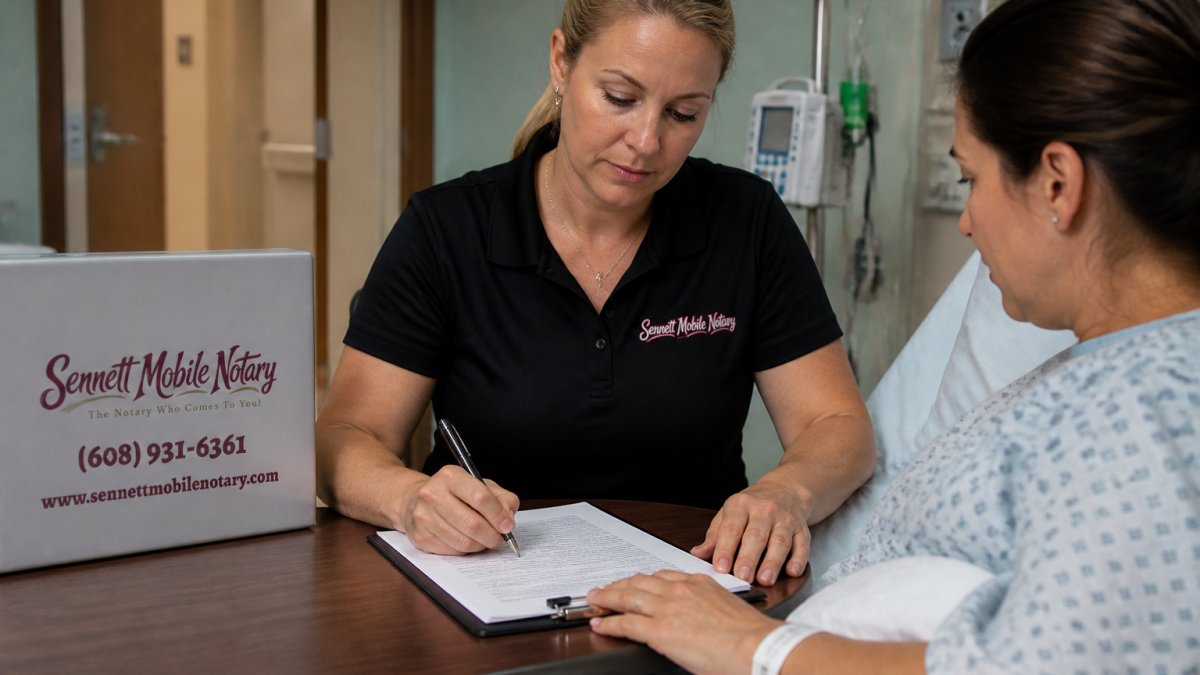
Handling a Signer Who Needs Extra Help
If the signer is elderly, unwell, or has difficulty understanding the documents, the notary is trained to be patient and clear. However, the notary's legal duty is to confirm the signer is competent and acting willingly. If the signer appears confused or unable to comprehend the transaction, the notary is required to stop the appointment. In this case, consult with the signer's attorney or a trusted family member to explore options like a power of attorney.
Watch Out Never share your documents or personal information with a notary who does not have a verifiable commission and a clear privacy policy. A legitimate professional will always be transparent about how your data is handled.
Smart Questions to Ask Before You Book
Booking a mobile notary is a matter of trust, especially when you are sharing sensitive financial documents. Asking the right questions upfront protects you from delays and potential fraud.
Are you a commissioned notary in my state? Confirm their commission is active and valid.
Do you carry errors and omissions insurance? This protects you if a mistake is made during the signing.
What is your experience with real estate closing packages? Loan signings are more complex than general notarizations.
What are your fees, and what do they include? Clarify the notary fee, travel fee, and any after-hours surcharges.
What is your policy on cancellations and lateness? Your closing deadline depends on their reliability.
A professional provider will answer these questions directly and provide proof of their commission and insurance. Many providers also offer rapid response times for urgent requests, which is critical when a closing date is approaching and a signing appointment falls through at the last minute (American Society of Notaries resource on hiring a notary).
Watch Out Never hire a notary who asks you to sign a document before they arrive or who suggests you can sign and they will "witness" it later. This violates notary law in every state and can invalidate your entire closing.
How to Handle a Signing When a Party Is Hard to Work With
Sometimes the person signing is elderly, unwell, or struggling to understand the documents. A skilled mobile notary for real estate knows how to handle these situations with patience and professionalism. The notary's job is to confirm the signer understands the document and is signing willingly, not to rush them through the process.
If the signer appears confused or unable to comprehend what they are signing, the notary may be legally required to stop the appointment. This is a protection for the signer, not an inconvenience. In these cases, it is wise to consult with the family member's attorney or the facility's social worker to determine the appropriate next steps, which may include a power of attorney or a competency evaluation.
The closing process carries real pressure, especially when your deadline is fixed and your schedule is full. A mobile notary removes the logistical hurdles by coming to you, offering flexible hours, and handling complex loan signings with professional care. At Sennett Mobile Notary, we bring that convenience to your preferred location across Southern Wisconsin, with rapid response times for time-sensitive closings and the experience to manage diverse document types. Book an appointment with Sennett Mobile Notary and get your real estate closing handled with speed and reliability.
Frequently Asked Questions
How much does a mobile notary for real estate cost?
The cost for a mobile notary at a real estate closing includes two parts: the notarization fee and a separate travel fee. The notarization fee for loan documents is often set by state law. The travel fee depends on the distance the notary must drive to reach you, as well as the time of day. For an exact quote, contact a mobile notary service and provide your location and the type of signing you need.
What is the difference between a general notary and a loan signing agent?
A general notary public performs standard notarizations, like verifying signatures on affidavits or powers of attorney. A loan signing agent is a notary with additional training specifically for mortgage and real estate closing documents. They understand the loan package, can guide you through the signing process, and know where your signature and initials are required on documents like the deed of trust and closing disclosure.
Do I need a mobile notary for my home closing, or can I go to a bank?
For many real estate transactions, the title company or lender requires a notary to witness your signature on the closing documents. While some closings happen in person at a title office, a mobile notary comes to your home, office, or another convenient location. This is essential for buyers who cannot travel due to time constraints, mobility issues, or distance, ensuring the signing appointment happens on your schedule.
What documents typically require a notary during a real estate transaction?
Your closing package, often called the loan package, is full of documents that require a notary. The most common ones are the deed of trust or mortgage, the promissory note, and the power of attorney. You may also need to sign an affidavit of title. The notary will verify your identity, witness your signature, and apply their notary seal to these specific pages.
How do I prepare for a mobile notary appointment for my real estate closing?
First, have your valid, government-issued photo ID ready, as the notary must verify your identity. Second, read your closing disclosure beforehand so you know what you are signing. Third, ensure you have a pen and a clear, well-lit table to sign on. Finally, do not sign any documents ahead of time; you must sign them in the notary's presence.
Book Appointment


Comments