
Mobile Notary for Legal Documents: Complete Guide
Updated: Sep 16
Table of Contents
What Is a Mobile Notary for Legal Documents?
Mobile Notary vs. Signing Agent: Key Differences
Types of Legal Documents You Can Notarize
Understanding Mobile Notary Fees and Travel Costs
Notarizing Legal Documents at Home: What to Expect
Hospital Notarization Services for Medical and Estate Documents
How to Prepare for Your Mobile Notary Appointment
Conclusion
Frequently Asked Questions
Last Updated: September 4, 2026
What Is a Mobile Notary for Legal Documents?
A mobile notary is a commissioned notary public who travels to your location to witness signatures, administer oaths, and verify identity on legal paperwork. Instead of driving to a bank or title office, the notary comes to your home, office, hospital room, or care facility. (Source: Wisconsin Statutes Chapter 140)
Powers of attorney, living wills, affidavits, and business contracts all require the same formalities: proof of identity, a willing signer, and a completed notarial certificate. When a document demands a notary and you cannot easily travel, a mobile service closes that gap. Sennett Mobile Notary brings that verification step directly to clients across Southern Wisconsin, including early mornings, evenings, and weekends.
Here is the part most guides skip: a notary does not validate the content of your legal documents. The notary validates the signing of them. State law governs who can serve as a notary public, how identity must be verified, and what must appear on the notarial certificate. The National Notary Association explains the core duties of a notary public, which center on identity verification, witnessing, and recordkeeping rather than legal advice.
Mobile Notary vs. Signing Agent: Key Differences
A mobile notary provides general notarization services at your location. A signing agent is a notary with additional training specifically for real estate and mortgage loan closings.
If you need a power of attorney notarized, a general mobile notary handles it. For a house closing, hire a signing agent who understands loan packages, deed terms, and signature sequencing across multiple documents.
Role | Primary Focus | Typical Documents | Additional Training |
Mobile Notary | General notarization | Affidavits, POAs, wills | State commission |
Signing Agent | Real estate closings | Loan docs, deeds, mortgages | Loan signing certification |
For complex loan signings, confirm the provider has signing agent experience before booking.
Types of Legal Documents You Can Notarize
A mobile notary can handle most paperwork requiring a notarial act. Understanding which documents require notarization and state-specific restrictions avoids costly delays.
Estate Planning Documents
Wills, living wills, and powers of attorney are commonly notarized at home. State law determines whether notarization is required. A notarized will becomes "self-proving," speeding probate. Powers of attorney often must be notarized for banks, healthcare providers, or government agencies to accept them. The notary must verify the signer understands the document and is signing willingly; if the signer appears confused or under pressure, the notary must decline.
Real Estate and Mortgage Documents
Deeds, mortgage notes, and loan documents require notarization in virtually all states. These documents often combine multiple notarial acts: an acknowledgment (confirming voluntary signing) and a jurat (requiring the signer to swear the contents are true). The notary must ensure all required signatures are present and the document matches the legal property description. Missing signatures or incomplete certificates can delay closing by days or weeks.
Financial and Business Documents
Corporate resolutions, partnership agreements, promissory notes, and I-9 verifications frequently require notarization. The notary verifies identity and willingness, not the signer's authority to bind the business.
Court and Government Filings
Affidavits and sworn statements require a jurat: the signer swears under oath that contents are true, with legal penalties for perjury. Some documents require an apostille, a special certification for international use, completed after notarization through your Secretary of State's office.
State-Specific Validity Rules
Before scheduling your appointment, confirm whether your document requires notarization in your state. For example, some states require a power of attorney to be notarized; others do not. Some states allow electronic notarization for certain documents; others do not. The Secretary of State or equivalent commissioning authority publishes notarization requirements by document type. If you are unsure, ask your mobile notary during the booking call, a professional provider will know the rules for your state and can advise whether notarization is necessary or recommended.
Document Integrity and Refusal
The notary must confirm the signer appears willing, understands the document, and presents valid identification. If a signer appears confused, medicated, under duress, or unable to comprehend the document, the notary must decline. This protects legal validity and prevents fraud.
Understanding Mobile Notary Fees and Travel Costs
Mobile notary fees consist of two components: the notarization fee (the act itself) and the travel fee (mileage and time). Understanding each prevents overpaying.
Notarization Fees: State Caps and Regulations
Each state sets a maximum fee per notarial act, published by the Secretary of State. Many states cap fees between $5 and $15 per act. A single document may require multiple acts, so you may be charged once per act, not once per document.
To find your state's fee cap, visit your Secretary of State's website and search for "notary public fees" or "notary regulations." The Secretary of State or equivalent commissioning authority maintains this information. If a notary quotes a fee above the state cap, you have the right to refuse and report the overcharge to your state's commissioning authority. Many notaries charge below the cap to remain competitive, but knowing the legal maximum protects you.
Travel Fees: What Is Reasonable
Travel fees are not capped by state law and vary by distance, time of day, and urgency.
Request a breakdown of the notarization fee and travel fee. A transparent provider itemizes both upfront. This helps you verify you are paying reasonable rates.
Emergency and After-Hours Premiums
After-hours appointments (early morning, evening, weekend) may incur additional charges. This premium guarantees availability when you need it. If your deadline allows flexibility, weekday scheduling saves money. (Source: Wisconsin Department of Financial Institutions (DFI) notary public information)
Loan Signing Fees
Signing agents may charge a flat fee for the entire closing package rather than per-act fees. Confirm whether travel is included or billed separately before booking.
How to Avoid Overpaying
Confirm your state's fee cap and compare it to the quote. Ask for travel fees separately. Ask about package rates for multiple documents. Schedule during business hours to avoid premiums. Rural areas typically have higher travel fees due to distance.
Payment and Cancellation Policies
Confirm payment method and cancellation policy before booking. Ask whether the travel fee is refunded if you cancel within 24 hours.
Notarizing Legal Documents at Home: What to Expect
When your mobile notary arrives, they review documents to identify the notarial act required. An acknowledgment confirms voluntary signing. A jurat requires you to swear the contents are true.
The notary verifies your identity with a valid government-issued ID and asks questions to confirm you understand the document and are signing willingly.
You sign the document in the notary's presence. The notary completes the certificate, applies their seal, and records the act if required. Most appointments take 15-30 minutes for a single document.
Do not sign the document before the notary arrives. Most certificates require the notary to witness your signature. Signing in advance voids the notarization.
Hospital Notarization Services for Medical and Estate Documents
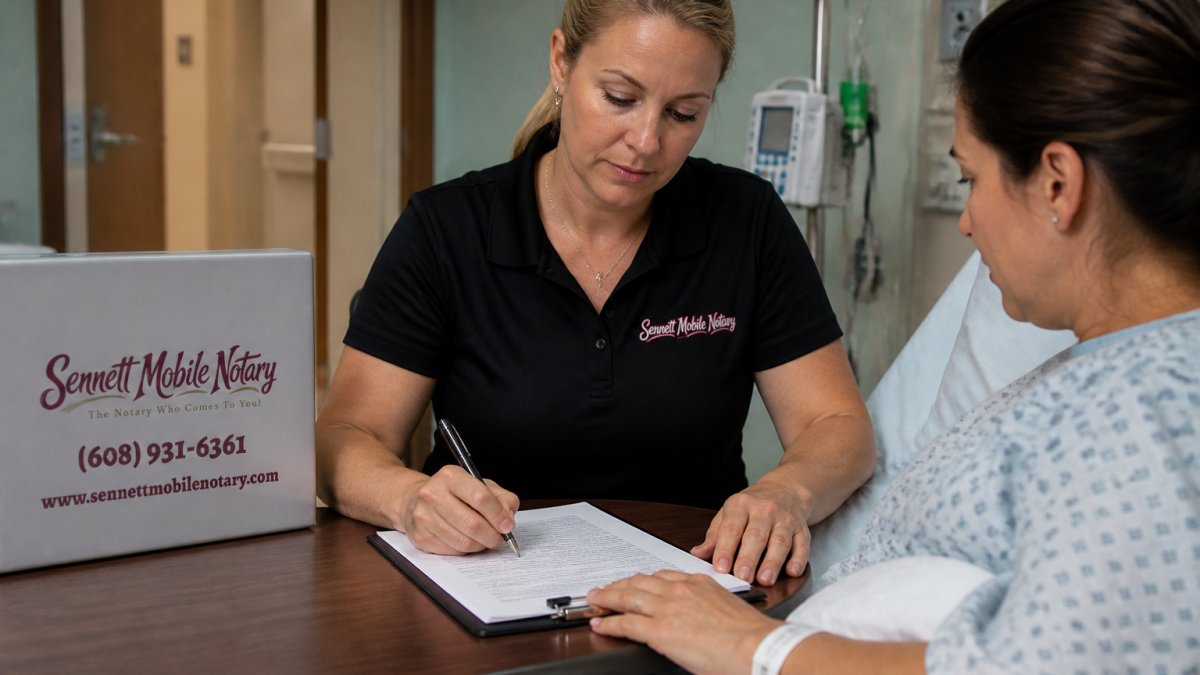
Hospital notarization services address urgent legal documents during health crises. Mobile notaries serving hospitals understand these situations require both speed and sensitivity.
Patients may be medicated, fatigued, or experiencing fluctuating mental clarity. The notary must assess whether the signer understands the document. If the patient is not coherent, the notary must decline, protecting legal validity.
The notary coordinates with facility staff for a suitable time and private space. Bedside notarization is possible when the patient cannot sit up.
Sennett Mobile Notary regularly handles time-sensitive hospital notarizations across Southern Wisconsin, responding quickly when medical and estate documents cannot wait. The American Society of Notaries provides guidance on notarizing for individuals with special needs, including those in healthcare settings.
How to Prepare for Your Mobile Notary Appointment
Preparation ensures your appointment goes smoothly. Follow this checklist before your mobile notary arrives.
Do not sign the documents. Gather valid identification for every person signing (current driver's license or state ID; expired IDs are not accepted). Confirm you have the complete document, including any pages requiring witnesses.
Ensure all signers will be present at the scheduled time. If witnesses are required, confirm they are available and not related to you or named in the document.
Communicate any special circumstances in advance: remote location, limited mobility, or specific time window. A professional notary plans their route around these details.

Watch Out The most common cause of a failed appointment is signing documents in advance. A notary cannot witness a signature that already exists on the page. If you sign early, the notary must refuse the notarization and the document may need to be reprinted and resigned.
Conclusion
A mobile notary for legal documents removes the biggest barrier to proper notarization: getting everyone to the same place at the same time. Whether you need estate documents finalized at home, a power of attorney signed in a hospital room, or loan documents completed before a closing deadline, the right provider makes the process seamless. The key is preparation, honest communication about the signer's capacity, and a notary who respects both the legal formalities and your schedule.
Sennett Mobile Notary brings professional document verification to your preferred location across Southern Wisconsin, with flexible hours and rapid response times for urgent matters. Our team handles general notarizations, complex loan signings, and hospital visits with the same standard of care. Book an appointment with Sennett Mobile Notary and get your legal documents signed with confidence.
Frequently Asked Questions
What types of legal documents can a mobile notary verify?
Mobile notaries can verify a wide range of documents including real estate deeds, loan documents, powers of attorney, affidavits, wills, trusts, and medical directives. However, certain documents like divorce decrees or court orders typically cannot be notarized. The notary's role is to witness the signer's identity and confirm they're signing willingly. Before scheduling, confirm with your mobile notary that they can handle your specific document type, as some complex legal instruments may have restrictions based on state law.
How do mobile notary fees typically work, and what affects the cost?
Mobile notary fees depend on several factors including the number of documents, location, time of service, and travel distance. Standard appointments during business hours generally cost less than evening or weekend services. Travel fees apply when the notary must come to your location. For exact pricing tailored to your situation, contact your mobile notary provider directly for a quote. Factors like same-day service or multiple signers may also influence the total cost.
What identification do I need to bring to a mobile notary appointment?
You must bring a valid government-issued ID such as a driver's license, passport, or state ID card. The notary will verify your identity to confirm you are who you claim to be before witnessing your signature. If your ID is expired or you lack government-issued identification, discuss alternatives with your mobile notary in advance. Having your ID ready speeds up the appointment and ensures the notarial certificate is valid.
Are mobile notary services legally binding?
Yes, mobile notarization is legally binding when performed by a commissioned notary public following state law requirements. The notary's seal, signature, and commission information on the notarial certificate authenticate the document. However, the document's legal validity also depends on whether it meets all other legal requirements for that document type. Mobile notarization offers the same legal authority as in-person notarization at a notary's office, the location doesn't affect the document's validity.
Can hospital notarization services handle documents for patients with cognitive concerns?
Hospital notarization services can assist with bedside notarization, but the notary must confirm the signer has capacity to understand the document and sign willingly. If a patient's mental state is questionable, the notary may decline to notarize or recommend medical evaluation first. For estate documents or medical directives involving patients with memory issues, discuss the situation with the facility and your mobile notary beforehand. They can advise whether the appointment should proceed and what documentation may be needed.
How quickly can mobile notary services accommodate urgent or same-day requests?
Many mobile notaries offer rapid response times for urgent situations, with same-day appointments often available depending on their current schedule. Early morning, evening, and weekend availability means you can often find time slots outside standard business hours. However, response speed depends on demand and the notary's service area. For time-sensitive closings or medical document needs, contact your mobile notary as soon as possible to confirm availability and discuss any rush fees that may apply.
Book Appointment

Comments