
Urgent Mobile Notary Near Me: 24/7 & Same-Day Help
Updated: Sep 16
Table of Contents
Why You Might Need an Urgent Mobile Notary Near Me Right Now
What Sets a Mobile Notary Apart from a Traditional Notary
Understanding Mobile Notary Fees Wisconsin Residents Pay
How an After-Hours Mobile Notary Handles Weekend and Evening Emergencies
Hospital Notarization Services: Bringing the Notary to the Bedside
What to Have Ready for Your Appointment
Identification Requirements: The Non-Negotiables
Document-Specific Must-Haves: A Field Guide for Urgent Signings
The 'Go Bag' for Hospital and Bedside Signings
Remote Online Notarization vs. Mobile Notary: Which Fits Your Urgent Need?
How Remote Online Notarization (RON) Works
The Critical Question: Will the Recipient Accept a Digital Signature?
A Decision Framework for Urgent Situations
The Hybrid Reality: When a Mobile Notary Is the Safer Bet
How to Verify a Notary's Credentials Before They Arrive
Frequently Asked Questions
Last Updated: September 6, 2026
When a closing deadline looms or a signed power of attorney is needed before surgery, waiting for standard business hours isn't an option. An urgent [mobile notary](/post/mobile-notary-for-legal-documents-complete-guide) near me provides the fastest path to getting documents verified, often arriving at your home, office, or hospital room the same day. This guide from Sennett Mobile Notary explains how urgent mobile notary services work and what to prepare so your signing goes smoothly.
Below, we’ll show you how to secure same-day or after-hours service, what distinguishes a mobile notary from a traditional one, and how to verify credentials. We’ll also cover the documents most commonly handled in urgent situations and the items you must have ready to avoid a failed appointment.
Why You Might Need an Urgent Mobile Notary Near Me Right Now
Urgent notarization requests rarely arrive during a lunch break. They tend to surface when a real estate closing is moved up, a family member is hospitalized, or a business deal requires an immediate signature. A mobile notary solves this by traveling to your location, removing the friction of finding a brick-and-mortar shop that is open.
Common triggers include real estate loan signings, estate planning documents, and legal affidavits that must be filed within a specific window. For residents across Southern Wisconsin, a commissioned notary public can arrive at a home, office, or care facility, often within hours of the initial call.
Watch Out Waiting until the last minute can cost you. Many document types, such as real estate closing packages, have strict deadlines where a missed notarization can delay the entire transaction. Contact a mobile notary as soon as you know a signing is needed, even if the exact time is still uncertain.
What Sets a Mobile Notary Apart from a Traditional Notary
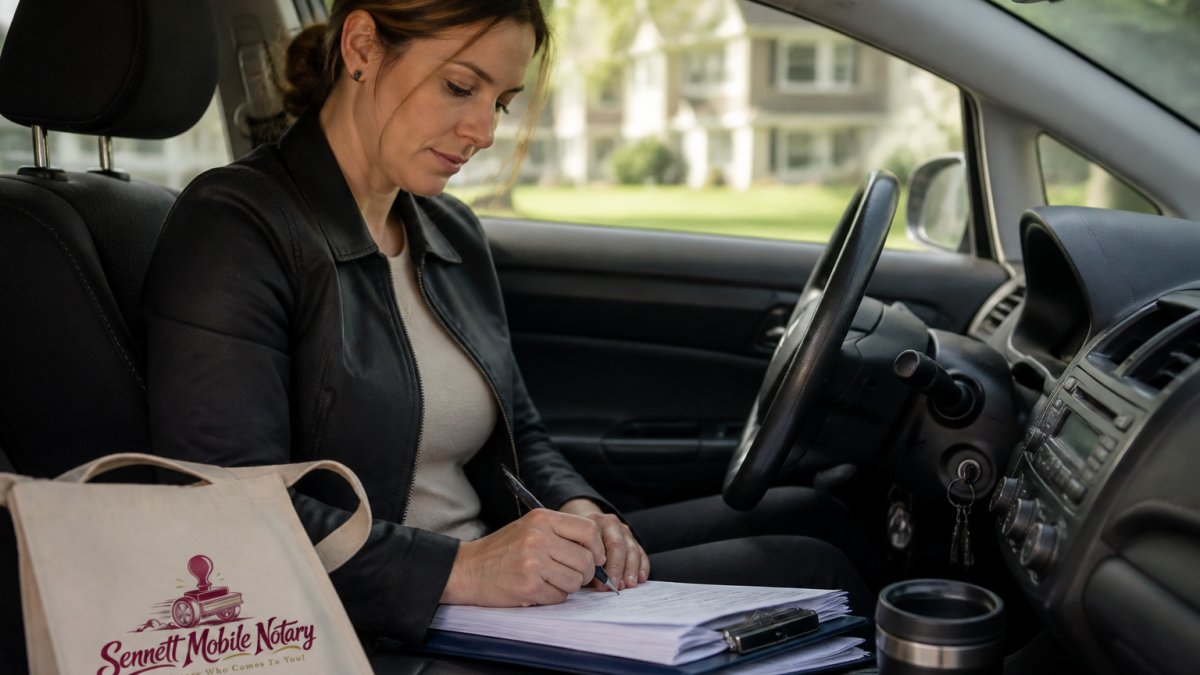
A traditional notary works from a fixed location, such as a bank, law office, or shipping store, during regular business hours. A mobile notary inverts this model by bringing the notary seal and expertise directly to you, which is essential when you are managing an urgent request.
With a mobile service, you are not restricted to a 9-to-5 schedule or a specific counter. The notary travels to your preferred location, which is valuable for individuals with limited mobility, busy professionals, or families coordinating a signing at a hospital.
Understanding Mobile Notary Fees Wisconsin Residents Pay
Pricing for mobile notary services is not a fixed, statewide number. The cost typically depends on the type of document, the distance the notary must travel, and the time of day. Mobile services include a travel fee to compensate for the notary's time and fuel, and after-hours, weekend, or holiday requests generally command a higher rate.
Given these variables, it is impossible to state a single price that applies to every urgent request. The most reliable approach is to request a quote from the specific provider you plan to use. For example, Sennett Mobile Notary offers flexible scheduling, including early mornings, evenings, and weekends, but the exact fee depends on your location and document type.
Cost Factor | How It Affects the Fee | What to Ask Your Provider |
Travel Distance | Longer trips increase the travel fee | Confirm the service area and any mileage charges |
Time of Day | Evenings and weekends cost more than business hours | Ask for the after-hours rate upfront |
Document Type | Loan signings may involve more time and liability | Verify if the fee is per signature or per appointment |
Urgency | Same-day requests may include a rush premium | Request a full quote before confirming the appointment |
How an After-Hours Mobile Notary Handles Weekend and Evening Emergencies
Weekend and evening emergencies are where mobile notaries prove their value. When a bank is closed and a traditional notary has gone home, an after-hours mobile notary remains available for real estate closings that must finalize before a Monday deadline or for families needing a power of attorney signed on a Saturday.
The process is straightforward: you call the provider, explain the urgency, and schedule a time. The notary then travels to your location, verifies your identity, witnesses your signature, and applies their official seal.
Pro Tip When booking an after-hours appointment, have your documents ready and your identification accessible before the notary arrives. This reduces the time the notary spends on site and helps you avoid an additional hourly fee for extended visits.
Hospital Notarization Services: Bringing the Notary to the Bedside
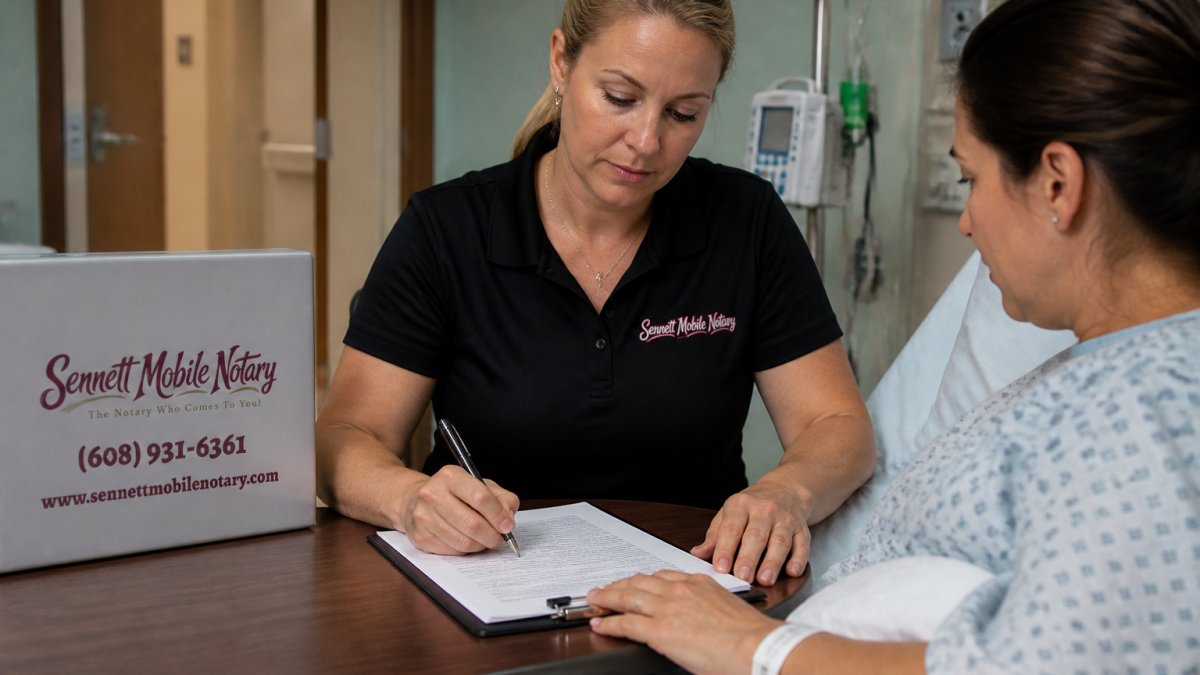
Hospital notarization services are a specialized form of mobile notarization for patients who cannot leave their room. These appointments often involve estate planning documents, such as wills, trusts, and healthcare directives, which require the patient's signature while they are still able to provide it.
The logistics require extra care. The notary must coordinate with the facility's staff, respect visiting hours, and ensure the patient is alert and willing to sign. If the patient cannot demonstrate understanding of the document, the notary is legally obligated to refuse the signing (nationalnotary.org).

What to Have Ready for Your Appointment
Preparation is the single most reliable way to ensure your urgent mobile notary appointment succeeds on the first visit. You must have both your documents and your identification ready. The notary cannot perform a notarization without valid identification, and the document cannot be signed after the fact.
Identification Requirements: The Non-Negotiables
Every signer must present a current, government-issued photo ID, such as a driver's license, state-issued ID card, or passport. The ID must be valid and not expired. If you do not have a qualifying ID, the notary may accept two credible witnesses, but this process is more complex and should be arranged in advance.
Watch Out A common point of failure is an expired ID. Check the expiration date on your driver's license or passport before you book the appointment. If it is expired, call your notary immediately to discuss the credible witness option, as this requires additional paperwork and planning.
Document-Specific Must-Haves: A Field Guide for Urgent Signings
Different document types have different requirements. Here is what you need for the most frequent urgent requests:
For Real Estate Closings:
The complete closing package provided by your lender or title company. Do not open it or sign any pages in advance.
A pen (black ink is standard).
Your checkbook if you are required to bring funds to closing.
All parties named on the title or loan documents must be present with their own valid IDs.
For Estate Planning Documents (Wills, Trusts, Healthcare Directives):
The final, unsigned version of the document. Do not sign it before the notary arrives.
Two witnesses (in addition to the notary) who are not beneficiaries of the estate. Confirm with your attorney whether your state requires witnesses to be physically present alongside the notary.
If the document is being signed at a hospital, notify the nursing staff in advance so they can confirm the signer is alert and not under the influence of medication that would impair their judgment.
For Powers of Attorney (Financial or Healthcare):
The principal (the person granting the power) must be present and mentally competent.
If the principal is physically unable to sign, they may make a mark, but the notary must be able to witness this and confirm their identity.
If you are acting as an agent under an existing POA, you generally do not need a notary to create the document, but you may need one to certify copies of it for banks or medical providers.
For Legal Affidavits or Court Documents:
The exact document that requires notarization, often provided by an attorney or court clerk.
Do not fill in any blanks that require the notary's witness. The notary cannot notarize a document with incomplete blanks that are meant to be filled in after the fact.
Pro Tip When you call to book your urgent appointment, ask the dispatcher this exact question: "Are there any specific witness requirements or additional forms I need to bring for a [document type]?" A professional service will walk you through the requirements for your specific document type and jurisdiction, saving you from a failed visit.
The 'Go Bag' for Hospital and Bedside Signings
If you are coordinating a signing at a hospital or nursing home, preparation is even more critical because the notary's time on-site may be limited by facility rules. Pack a folder with the unsigned documents, the signer's valid ID, and a list of the witnesses' names and contact information. Have the signer's room number and the facility's main phone number ready, as the notary will need to check in at the front desk.
Remote Online Notarization vs. Mobile Notary: Which Fits Your Urgent Need?
When you search for an "urgent mobile notary," you might assume an in-person visit is your only option. However, Remote Online Notarization (RON) has become a viable alternative in many states. The decision is not about which is 'better', it is about which method your specific document and the receiving institution will accept.
How Remote Online Notarization (RON) Works
RON allows a commissioned notary to witness your signature over a secure audio-video connection. The process involves uploading your document to a platform, verifying your identity through knowledge-based authentication questions, and signing electronically while the notary watches via webcam. The entire process can be efficient if you are comfortable with the technology.
The Critical Question: Will the Recipient Accept a Digital Signature?
The single biggest risk with RON is that the entity receiving your document, a bank, a title company, a probate court, or an out-of-state institution, may not accept a digitally notarized document. Many real estate lenders still mandate a 'wet-ink' signature with a physical notary seal, and some courts require an original physical document for filing. Before you book a RON session, call the recipient and ask: "Do you accept remotely notarized documents with an electronic seal, or do you require a physical ink signature from a mobile notary?"
A Decision Framework for Urgent Situations
Use this quick checklist to choose the right path:
Choose RON if:
You have a stable internet connection, a computer with a camera, and basic tech proficiency.
The receiving institution has confirmed they accept electronic notarization.
The document is a standard form (e.g., a simple affidavit, a refinance document from an online lender) that does not require physical witnesses.
You are located in a state where RON is authorized, and the notary is commissioned in that state.
Choose a Mobile Notary if:
The document is a real estate closing package, a will, a trust, or a power of attorney that requires physical witnesses or a wet-ink signature.
The receiving institution is a traditional bank, a court, or a government agency that has not explicitly confirmed RON acceptance.
You are at a hospital or care facility where the signer may not be able to navigate a digital platform.
You have multiple pages to sign, and the digital upload process would be error-prone.
Watch Out Even if your state allows RON, the notary must be commissioned in the state where you are physically located at the time of the signing. You cannot use a notary from another state for a RON session. This is a common point of confusion that leads to failed signings.
The Hybrid Reality: When a Mobile Notary Is the Safer Bet
For urgent requests where you are unsure of the recipient's technical requirements, a mobile notary is the safer choice. An in-person notarization with a physical seal is widely accepted by institutions. If you are facing a hard deadline, like a closing that must fund by 5:00 PM, the last thing you want is a rejected RON session that forces you to scramble for an in-person notary at the last minute.
How to Verify a Notary's Credentials Before They Arrive
Before you grant access to sensitive documents or invite someone into your home, confirm that the notary is properly commissioned. Ask for their notary ID number and the county where they are commissioned. In Wisconsin, notaries are commissioned by the state, and you can verify their status through the Wisconsin Department of Financial Institutions' online database.
You should also confirm that the notary carries a surety bond and an errors and omissions insurance policy, which protect you in the event of a mistake. A professional mobile notary will be happy to provide this information. The Wisconsin Department of Financial Institutions notary search tool allows you to verify an active commission quickly. Additionally, the National Notary Association's guide on verifying credentials recommends checking that the notary's commission has not expired and that their seal matches the name on their ID.
Key Takeaway Always verify a notary's commission before the appointment. A quick search on the Wisconsin Department of Financial Institutions website takes less than two minutes and protects you from fraudulent or expired credentials.
For most urgent requests in Southern Wisconsin, a mobile notary offers the speed, flexibility, and reliability that a traditional storefront cannot match. Sennett Mobile Notary brings professional document verification directly to your location with flexible scheduling for early mornings, evenings, and weekends, ensuring your time-sensitive documents are handled correctly.
Frequently Asked Questions
What documents require an urgent mobile notary?
Time-sensitive documents often require urgent mobile notary services. Common examples include real estate closing papers, loan signings, power of attorney forms, and medical directives. If a deadline is hours away or a loved one is in the hospital, a mobile notary can travel to your location to witness signatures and apply their official seal without delay.
How do I verify a mobile notary's credentials in Wisconsin?
Before an appointment, ask for the notary's commission number and expiration date. You can verify this information through the Wisconsin Department of Financial Institutions' online database. A professional mobile notary will also carry their official notary seal and a journal of notarial acts, which they should be willing to show you upon arrival.
How much is a notary mobile service for an urgent request?
For urgent appointments, mobile notary fees are often higher than standard in-office rates. The total typically includes a base service fee plus a travel fee based on distance. For an exact quote, contact the service provider directly. Sennett Mobile Notary offers transparent pricing based on your specific location and document type.
Can a mobile notary meet me at a hospital or care facility?
Yes, most mobile notaries provide hospital notarization services. They regularly visit hospitals, nursing homes, and assisted living facilities to notarize estate planning documents or medical forms. When scheduling, inform the notary of the facility's location and any visitor policies, such as check-in procedures or required masking, to ensure a smooth visit.
Getting a document notarized under pressure is stressful, but the process itself does not have to be. You need a provider who shows up on time, handles complex documents with care, and operates on your schedule. Sennett Mobile Notary offers rapid response times, a comprehensive service area across Southern Wisconsin, and professional handling of everything from loan signings to hospital notarizations. Book an appointment with Sennett Mobile Notary and get your documents signed with confidence.
Book Appointment
Comments