
Dane Mobile Notary Alternative: 2026 Guide
Updated: Sep 16
Table of Contents
Why Busy Professionals Seek a Dane Mobile Notary Alternative
Mobile vs. Remote Online Notarization: A Step-by-Step Comparison
When Mobile Service Wins
When Remote Online Notarization Works Better
How Mobile Notary Fees Wisconsin Compare Across Options
Loan Signing Agent Services for Real Estate Closings
Hospital Mobile Notary Requirements and Care Facility Visits
Cost-Benefit Analysis: Mobile vs. Traditional Office Visits
What to Look for in a Mobile Notary Alternative
Frequently Asked Questions
Last Updated: September 12, 2026
Why Busy Professionals Seek a Dane Mobile Notary Alternative
A mobile notary alternative is any commissioned official who travels to you, or any remote online notarization (RON) platform that completes a notarial act over video, instead of requiring a storefront visit. Demand has grown because closings, estate documents, and medical paperwork rarely wait for business hours.
At Sennett Mobile Notary, clients across Southern Wisconsin report the same three frustrations: rigid scheduling, slow response on urgent signings, and surprise travel fees. A 6 a.m. Saturday closing, a power of attorney signed at a hospital bedside, or a stack of I-9 verifications all fall outside the 9-to-5 window, exactly where a mobile notary alternative earns its place.
Below: how mobile service compares with remote online notarization, what drives mobile notary fees in Wisconsin, and how to prepare so your appointment succeeds the first time.
Mobile vs. Remote Online Notarization: A Step-by-Step Comparison
The two paths diverge at the identity check: mobile service verifies you in person, while RON uses knowledge-based authentication and credential analysis on camera.
Mobile notarization, step by step:
You book a time and location, including after-hours slots.
The notary confirms your identity with a government-issued photo ID in person.
You sign in wet ink in front of the notary.
The notary completes the certificate, applies the stamp, and records the act in their journal.
You keep the original executed document immediately.
Remote online notarization, step by step:
You upload the document to the platform.
The system runs identity verification, often with knowledge-based questions.
You join a live video session with a remote notary.
You sign electronically; the notary applies a digital seal.
The platform stores an audio-video recording of the session and returns a completed file.
That recording requirement is the detail most comparisons skip: RON sessions are typically recorded and retained, which some signers find reassuring and others intrusive.
When Mobile Service Wins
Physical presence still decides many transactions. Wet-ink documents, court filings, and anything a title company insists on seeing signed in person generally need a mobile notary, as do signers uncomfortable with technology, including many older adults handling wills and trusts.
When Remote Online Notarization Works Better
RON shines for speed and cost. A platform like OneNotary lists sessions with no travel fee and around-the-clock availability, for a business owner notarizing routine corporate documents at 11 p.m., that beats waiting for a mobile visit. The trade-off: if the receiving party won't accept a digitally sealed document, you've saved money and lost a day.
Pro Tip Ask the receiving party one question before you book anything: "Will you accept an electronically notarized document?" The answer decides whether you need a mobile notary at all, and it takes thirty seconds to get.
How Mobile Notary Fees Wisconsin Compare Across Options
Mobile notary fees in Wisconsin are not a single number. State law caps the per-act fee, while travel, after-hours scheduling, and loan signing work are priced separately by the provider, which is why two quotes for the same signing can differ widely.
Here's how the main options stack up:
Option | Cost Structure | Best For | Watch Out For |
Mobile notary (direct) | Per-act fee plus travel and after-hours charges | Closings, hospital visits, wet-ink documents | Travel fees vary by distance and time |
Remote online notarization | Flat per-session fee, no travel | Routine documents, late-night needs | Some recipients reject digital seals |
Notary marketplace | Variable hourly or per-job rates | Comparing several local providers | Quality and availability vary widely |
Traditional office visit | Lowest per-act cost | Simple documents, flexible schedule | You handle the travel and the wait |
For our own pricing, including travel and after-hours terms, Sennett Mobile Notary's service and booking page lays out current rates before you commit.
Watch Out The most common billing surprise is a travel fee quoted for one address and applied to another. Confirm the service address in writing when you book, especially for signings at a care facility or a property that hasn't closed yet.
Loan Signing Agent Services for Real Estate Closings
A loan signing agent is a notary with additional training in mortgage documents, hired to guide a borrower through the signing package at the closing table. The role goes beyond stamping: the agent checks that names match across documents, flags missing pages, and returns the package promptly so funding isn't delayed.
Real estate agents and mortgage brokers book mobile signing agents for three reasons: borrowers sign at home or work instead of a title office; back-to-back signings become possible when the agent travels to each client; and the agent catches missed signatures before the package leaves the room, protecting the closing date.
The practical question is capacity. If you're scheduling multiple closings in one week, confirm the notary can handle consecutive appointments and has a plan for traffic and distance between them. The National Notary Association publishes guidance on signing agent responsibilities and journal requirements that's worth reviewing before you hire.
Key Takeaway For loan signings, the notary's punctuality matters more than their price. A late arrival at a closing table costs everyone in the transaction, not just the borrower.
Hospital Mobile Notary Requirements and Care Facility Visits
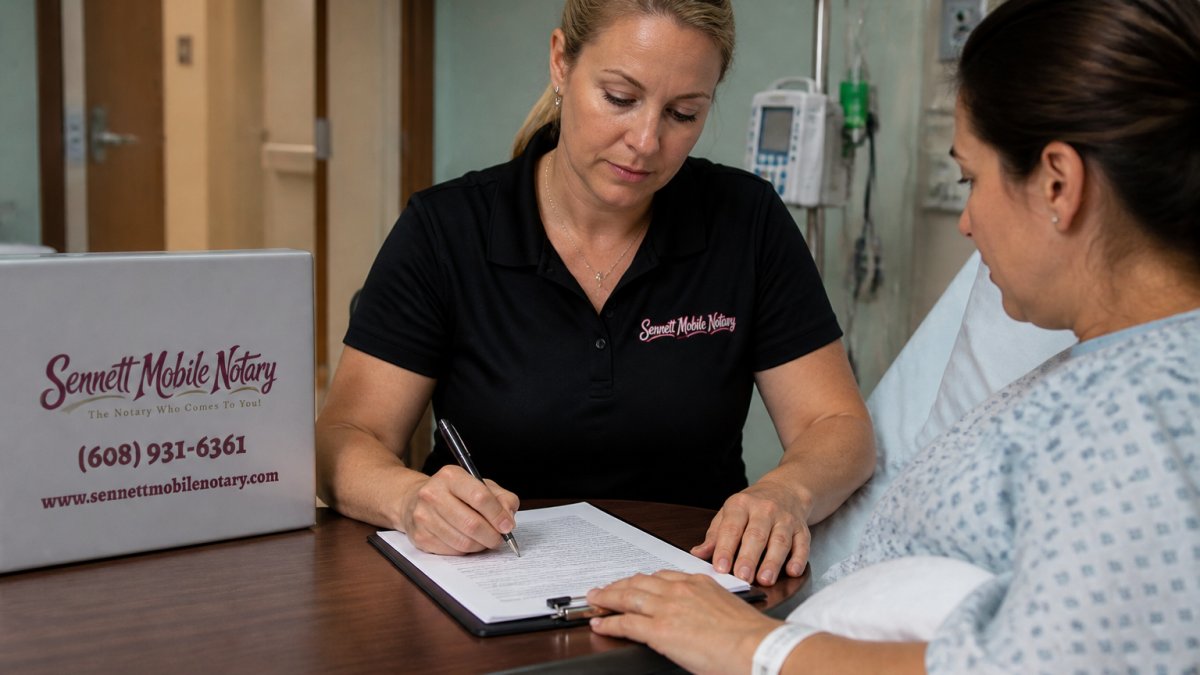
Hospital and care facility notarization differs from a standard appointment in one key way: the signer's awareness. A notary must be satisfied the signer is willing and understands what they're signing. If a patient is confused, medicated, or drifting in and out of coherence, the notary can decline to proceed, protecting the document's legal validity.

Leave every signature line blank until the notary is present. A pre-signed document cannot be notarized as-is; the signer must sign again in the notary's presence, which usually means reprinting and sometimes rescheduling.
Bring a current government-issued photo ID, driver's license, state ID, U.S. passport, or military ID. The name must match the document; a middle initial on one but not the other is a common reason a notary pauses.
Confirm whether the document requires witnesses, and have them physically present. Many estate documents, some powers of attorney, and certain real estate instruments need one or two witnesses beyond the notary. A witness cannot be the notary, and in most states cannot be a named beneficiary or heir (nationalnotary.org).
Review the document for blank fields the signer must complete, dates, dollar amounts, property descriptions. A notary cannot fill these in, and an incomplete document may need redrafting.
Verify the appointment address and any parking, gate, or entry instructions. Care facilities and gated properties often require front-desk check-in, which adds time.
Have payment ready if the provider collects at the appointment. Many mobile notaries accept cash, card, or a payment link sent before arrival.
Ask the receiving party in advance: will they accept an electronically notarized document, or do they require wet ink? The answer decides whether you need a mobile notary at all.
At the appointment
The signer must be physically present, awake, and able to communicate understanding of what they're signing. A notary not satisfied on this point can decline to proceed, protecting the document's validity.
Sign in the notary's presence, in ink, on the correct lines, exactly as the name appears on the ID unless the document specifies otherwise.
Watch the notary complete the certificate, the wording stating who appeared, on what date, and in what capacity. The certificate is the notary's statement, not the signer's.
Confirm the notary records the act in their journal if your state requires it. Most states require a journal entry for at least some acts, typically capturing the date, signer's name, document type, and ID presented (nationalnotary.org).
Take the original executed document with you. If the receiving party needs a certified copy, ask in advance whether the notary offers copy certification; not every notary does, and some states restrict it.
Common reasons an appointment fails on the first try
The document was signed before the notary arrived.
The ID name doesn't match the document name.
A required witness didn't show up.
The signer is not lucid or not able to communicate understanding.
The document is missing pages or has blank required fields.
The receiving party rejects the format after the fact.
Watch Out Do not sign anything "just to get it out of the way" before the notary arrives. A pre-signed document is the single most common reason a mobile notary visit has to be repeated, and the second visit is rarely free.
Pro Tip If the signer is in a hospital or care facility, call the unit ahead of time and ask two questions: what are the visitor rules for a notary, and is there a predictable window when the patient is most alert? Scheduling around medication cycles is the difference between a completed signing and a wasted trip.
Cost-Benefit Analysis: Mobile vs. Traditional Office Visits
The cheapest option on paper is rarely cheapest in practice. Most comparisons stop at the per-act fee and never add the costs that decide the outcome: your time, the trip, the failure rate, and the cost of a second attempt.
The four cost lines that matter
Notarial fee per act. The number every provider quotes first, and the smallest line in most transactions.
Travel and time. An office visit carries your drive time, parking, and counter wait; a mobile visit carries the notary's travel fee, priced to cover the same trip.
Failure cost. A failed first attempt, missing witness, ID mismatch, pre-signed document, means paying for a second. Mobile visits fail less often because the notary manages the mechanics in person.
Opportunity cost. For a professional billing hourly, two hours of round-trip travel is the largest line item, and it never appears on a receipt.
A worked example
Suppose a signer needs one document notarized and lives 30 minutes from the nearest office.
Office visit: low per-act fee, plus roughly an hour of round-trip drive time, parking, and the risk of arriving during a closure or lunch break. If the first attempt fails, the trip repeats.
Mobile visit: higher per-act fee plus travel, but the notary absorbs the drive, brings the journal and stamp, and can usually resolve a missing detail on the spot.
Remote online notarization: flat per-session fee with no travel, but only if the receiving party accepts a digitally sealed document.
Mobile wins when the signer's time is worth more than the travel fee, when mobility is limited, or when a failed first attempt is expensive. The office visit wins when the signer is near the office, flexible, and the document is simple.
When mobile isn't a premium, it's the only path
For a signer with limited mobility, a hospital patient, or someone in a care facility, an office visit may not be physically feasible at all. The travel fee isn't a luxury surcharge; it's the cost of doing the transaction at all, a reframing that matters when a family weighs quotes.
The three-way decision
Before you book anything, run the decision in this order:
Does the receiving party accept a digitally sealed document? If yes, RON is usually fastest and cheapest, with no travel.
If not, does the signer need wet ink or physical presence? If yes, mobile service is the practical answer; the only question is which provider.
Is the signer mobile, near an office, and flexible? If yes, an office visit may be the lowest total cost, but only if the first attempt succeeds.
Key Takeaway Compare total cost per completed transaction, not per act. A modest travel fee that prevents a second trip is cheaper than a low per-act fee that has to be paid twice.
Pro Tip If you're booking several signings in one week, ask whether the provider offers scheduling for multiple appointments in a single block. Back-to-back bookings reduce travel overhead and usually produce a better rate than separate calls.
What to Look for in a Mobile Notary Alternative
Credentials come first, and they're easy to verify. A legitimate notary holds a current commission in the state where the act takes place, carries a surety bond, and maintains a journal for certain acts. Ask for commission status directly; any professional answers without hesitation.
Then weigh the operational details that determine whether the appointment actually happens:
Scheduling range. Early mornings, evenings, and weekends matter more than a low base rate when your deadline is Friday.
Response time. For urgent signings, ask how quickly the notary can confirm and arrive.
Service area. Confirm coverage extends to your address, including rural parts of the region.
Experience with your document type. Estate documents and loan packages are different jobs.
Communication. A notary who confirms the appointment in writing and follows up is a notary who shows up.
Sennett Mobile Notary was built around those five points: we travel to your preferred location, schedule early mornings through weekends, respond quickly when a signing can't wait, and cover multiple counties across Southern Wisconsin. For a closing deadline, a bedside signing, or an after-hours corporate document, that combination turns a stressful errand into a completed appointment.
Frequently Asked Questions
What should I look for when hiring a mobile notary alternative?
Verify the notary is state-commissioned in Wisconsin, check their service area covers your location, and confirm they carry errors and omissions insurance. Ask about availability for after-hours or emergency services, and whether they handle your specific document type. Read recent reviews to gauge reliability. A notary who specializes in loan signing agent services or hospital visits will have relevant experience for those situations.
How do mobile notary fees Wisconsin work?
Wisconsin sets a maximum fee for each notarial act, and mobile notaries add a travel fee on top of that. The travel fee varies by distance, time of day, and urgency. Some providers charge a flat trip fee; others calculate per mile. For loan signings, the fee is often bundled into closing costs. Always ask for a full quote upfront that separates the notarial act fee from the travel fee.
Can a mobile notary assist with complex loan signing packages?
Yes, but you want a notary who works as a loan signing agent. These professionals are trained to handle mortgage documents, disclosures, and closing packages correctly. They know which pages need notarization, how to handle witness requirements, and how to return documents promptly. For real estate closings, confirm the notary has experience with your lender's specific package and can accommodate back-to-back appointments if needed.
Are mobile notary services available for hospital and nursing home visits?
Many mobile notaries offer hospital and care facility visits, but hospital mobile notary requirements vary. Some facilities restrict who can enter patient rooms or require advance notice. The notary must verify the signer is coherent and signing voluntarily. For patients who may be confused, the notary will assess capacity before proceeding. Schedule ahead when possible and confirm the facility allows notary visits.
Is remote online notarization a valid alternative to a mobile notary?
Remote online notarization (RON) is legal in Wisconsin for many document types, but not all. Documents requiring a wet signature or physical presence, such as certain wills and trusts, may still need an in-person notary. RON works well for power of attorney, affidavits, and some business documents. Check with the receiving party to confirm they accept RON before choosing that route.
Notarization deadlines rarely move, and the cost of a missed appointment falls on you, not the notary. Sennett Mobile Notary handles on-site document verification at your location, with flexible scheduling that includes early mornings, evenings, and weekends, plus rapid response for time-sensitive signings across Southern Wisconsin. Get started with Sennett Mobile Notary and book an appointment that fits your deadline instead of the other way around.
Book Appointment

Comments