
How to Notarize Estate Documents: Step-by-Step
Table of Contents
Understanding Estate Document Notarization
Documents That Require Notarization in Estate Planning
Mobile Notary for Estate Planning: When and Why You Need It
Witness Requirements for Wills and Other Estate Documents
Step-by-Step Process for Notarizing Estate Documents
Step 1: Verify Signer Identity
Step 2: Confirm Legal Capacity and Voluntary Signature
Step 3: Execute the Document and Obtain Signatures
Step 4: Complete the Notarial Certificate
Notarizing Power of Attorney Documents
Self-Proving Affidavits and Statutory Requirements
Common Mistakes to Avoid
Frequently Asked Questions
Last Updated: September 24, 2026
Understanding Estate Document Notarization
To notarize estate documents, a notary public verifies signer identity and confirms voluntary execution with legal capacity. This creates a presumption of validity that saves heirs time and expense during probate.
Sennett Mobile Notary serves Southern Wisconsin, bringing notarization to your home, care facility, or office. Proper notarization prevents challenges to wills or trusts years later, a single missing signature or improperly executed acknowledgment can trigger costly probate disputes.
A notarized document is presumed valid unless proven otherwise; an unnotarized document shifts the burden of proof to whoever wants to enforce it, a heavy burden in estate planning.
Documents That Require Notarization in Estate Planning
Not every estate document needs notarization, but the critical ones do. Understanding which papers require a notary's seal prevents costly mistakes later.
Wills are the foundation of most estate plans. A notarized will with a self-proving affidavit bypasses probate challenges; if contested later, the notarial certificate proves the testator's identity and willingness at execution.
Living trusts hold assets during your lifetime and transfer them after death without probate, requiring notarization in most states. This prevents beneficiaries from questioning the grantor's legal capacity or whether they were pressured.
Powers of attorney grant someone authority to act on your behalf. Durable financial powers of attorney almost always require notarization; healthcare powers of attorney vary by state but are safer when notarized. Financial institutions and healthcare providers often demand notarized versions.
Healthcare directives and living wills spell out end-of-life wishes. While not always required to be notarized, hospitals and care facilities treat notarized versions as more authoritative and reduce delays in urgent medical decisions.
Deeds and property transfers within an estate plan require notarization, creating an official record and preventing disputes about ownership and timing.
Affidavits of heirship help transfer small estates without full probate. These must be notarized to carry legal weight.
The common thread: documents that affect property, money, or major life decisions should be notarized. It's the safest choice for anything your heirs might challenge or a financial institution might question.
Mobile Notary for Estate Planning: When and Why You Need It
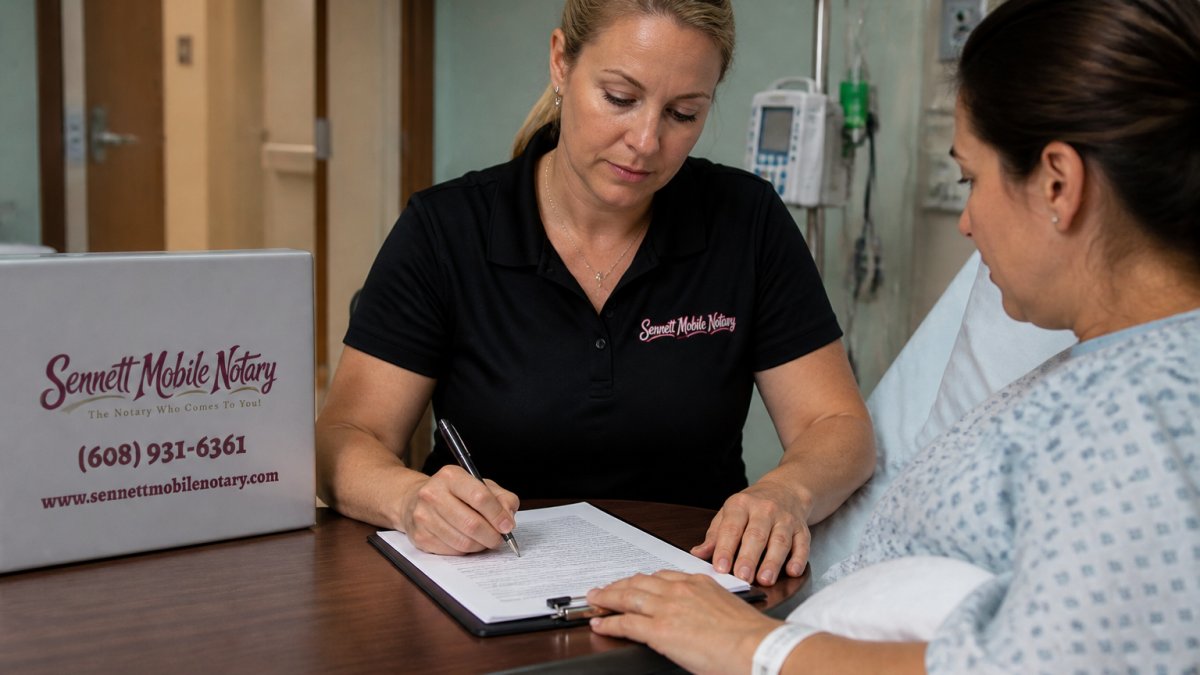
A mobile notary brings professional document verification to you, especially valuable for estate planning involving seniors, people with mobility challenges, or time-sensitive situations.
When you need a mobile notary:
You're in a care facility or hospital and can't travel to a notary's office
You have limited mobility due to age or illness
You want documents notarized at home for privacy and comfort
You need notarization outside standard business hours
Multiple family members need to sign and coordinate schedules is difficult
You're managing an estate quickly and can't wait for appointments
Mobile notaries verify identity and legal capacity as thoroughly as office-based notaries, with added convenience and accessibility. Sennett Mobile Notary serves Southern Wisconsin with flexible scheduling including early mornings, evenings, and weekends, critical when managing an estate or facing a medical situation.
Mobile notaries handle complex situations better, assessing capacity in context and answering questions about witness requirements and document execution on the spot.

Mobile notary costs are justified when time is short or access is limited, you avoid travel, get rapid service, and have a professional handling documents that affect your family's future.
Witness Requirements for Wills and Other Estate Documents
Witness requirements vary by state, but witnesses must be present, see the testator sign, sign the document themselves, be mentally competent, and have no financial interest in the estate.
Tamika TaShay
Who can't be a witness:
Beneficiaries named in the will
Spouses of beneficiaries
Anyone who stands to inherit if the will is invalid
Anyone under the legal age of majority (usually 18)
Anyone lacking mental capacity to understand what they're witnessing
How many witnesses are needed:
Most states require two witnesses for a will; some accept one, a few require three. Having more witnesses than required adds protection against later challenges.
What witnesses must do:
Witnesses must be present while the testator signs, see the signature (or acknowledge one already made), sign the document themselves in the presence of the testator and each other, and be aware they're witnessing a will.
Witness signature location:
The witness signatures go on the will itself, usually at the end. The notarial certificate goes below the witness signatures. This order matters. A notary verifies the witness signatures and the testator's acknowledgment of the document.
Witnesses attest that they saw the testator sign; a notary verifies signer identity and confirms voluntary action. Both add layers of validity to estate documents.
Step-by-Step Process for Notarizing Estate Documents
The process to notarize estate documents follows a standard sequence. Understanding each step helps you prepare and ensures nothing is missed.
Step 1: Verify Signer Identity
The notary must confirm the signer's identity through government-issued photo identification. A driver's license, passport, or state ID card is standard. The notary will examine the photo, check the signature on the ID, and compare it to the signer in front of them.
For estate documents, a photo ID is essential, it removes doubt and strengthens the notarial certificate.
The notary records the ID number, issuing state, and expiration date on the notarial certificate, creating an official record of who signed and when.
Step 2: Confirm Legal Capacity and Voluntary Signature
Before notarizing, the notary confirms the signer understands the document and is signing freely. For estate documents, the signer should explain what the document does in basic terms, they don't need to recite every detail, but must understand they're creating or modifying an estate plan.
If the signer shows signs of confusion, memory loss, or undue influence, the notary may decline to notarize, protecting the signer and document validity.
Step 3: Execute the Document and Obtain Signatures
The signer must sign in the notary's presence. The testator or grantor signs first, usually at the end; witnesses sign next if required. For a self-proving affidavit, the testator and witnesses all sign in the notary's presence, making the will self-proving and avoiding probate challenges.
The signer should use the name that appears on their ID; the notary will note any discrepancy on the certificate.
Step 4: Complete the Notarial Certificate
The notarial certificate is the official record of the notarization. It includes:
The date of notarization
The signer's name and the name on their ID
The document title (e.g., "Last Will and Testament")
A statement that the signer appeared before the notary, provided ID, and signed voluntarily
The notary's signature and seal
The notary's commission number and expiration date
The certificate goes on a separate page attached to the document or in a space left at the end of the document. Some documents have a pre-printed certificate; others require the notary to add one.
The notary's seal (an embossed stamp or ink impression) is applied to the certificate. This seal is what makes the notarization official and verifiable. Banks, courts, and government agencies recognize the seal as proof of notarization.
Notarizing Power of Attorney Documents
A power of attorney is a legal document that grants someone authority to act on your behalf. It's a critical estate planning tool, and most financial institutions require it to be notarized.
Types of powers of attorney:
A durable power of attorney for finances gives someone authority to manage your money and property, remaining valid if you become incapacitated, the type most commonly notarized.
Notarization requirements:
Why notarization matters:
Self-Proving Affidavits and Statutory Requirements
A self-proving affidavit is a separate document that accompanies a will. It contains sworn statements from the testator and witnesses confirming that the will was executed properly. Once notarized, the affidavit allows the will to be admitted to probate without calling witnesses to testify about the execution.
What a self-proving affidavit includes:
Statements from the testator and witnesses confirming voluntary signature and sound mind
Sworn statements that the will was executed according to law
Notarization of all signatures
How it works:
Statutory requirements vary by state:
Common Mistakes to Avoid
Estate document notarization is straightforward, but mistakes happen. Knowing what to avoid prevents delays and protects your documents.
Mistake 1: Using the wrong name on the signature
Mistake 2: Signing without the notary present
Mistake 3: Missing witness signatures
Mistake 4: Not understanding the document
Mistake 5: Forgetting to bring ID
Mistake 6: Waiting until the last minute
Mistake 7: Assuming notarization makes a document legal
Frequently Asked Questions
Can a notary also serve as a witness for a will?
No. A notary public cannot serve as a witness to a will in most jurisdictions. The notary's role is to verify the signer's identity and confirm the signature is genuine, while a witness attests to the testator's mental capacity and voluntary execution. These are separate legal functions. Some states prohibit notaries from witnessing wills entirely to avoid conflicts of interest. Always check state statutes for your specific requirements.
What is the difference between a self-proving affidavit and a standard notarization?
A self-proving affidavit is a notarized statement signed by witnesses and the testator that declares the will was executed properly and the testator had legal capacity. It streamlines probate by eliminating the need for witnesses to testify later. Standard notarization simply verifies the signer's identity and confirms the signature is genuine without addressing the document's validity or the signer's mental state. Self-proving affidavits require specific statutory language and are more complex than basic notarizations.
Do all estate planning documents require notarization?
Not all estate documents require notarization, but many do for validity or to avoid probate complications. Wills typically need witness signatures but notarization is optional in many states. Living trusts, powers of attorney, and healthcare directives often require notarization to be legally binding. Self-proving affidavits must be notarized. Requirements vary by state and document type. Consult an attorney or your state's probate statutes to determine which documents in your estate plan need notarization.
How do mobile notaries handle situations where the signer lacks mental capacity?
A notary public cannot notarize a document if the signer lacks legal capacity to understand the document or the notarization process. The notary must assess the signer's ability to comprehend what they are signing and confirm voluntary execution. If the signer appears confused, disoriented, or unable to communicate, the notary should decline the service. For individuals with cognitive decline or medical conditions, family members should consult an elder law attorney before attempting notarization to ensure documents are executed while the person retains legal capacity.
Book Appointment

Comments